Building a Claude Code Skill That Reads Your Own Systems and Refuses to Invent
Watch the 49-second stage intro it made, then how I built it: a Claude Code skill that gathers evidence from a notes vault, GitHub and the public web, keeps a claim ledger, and writes a founder profile it can defend.
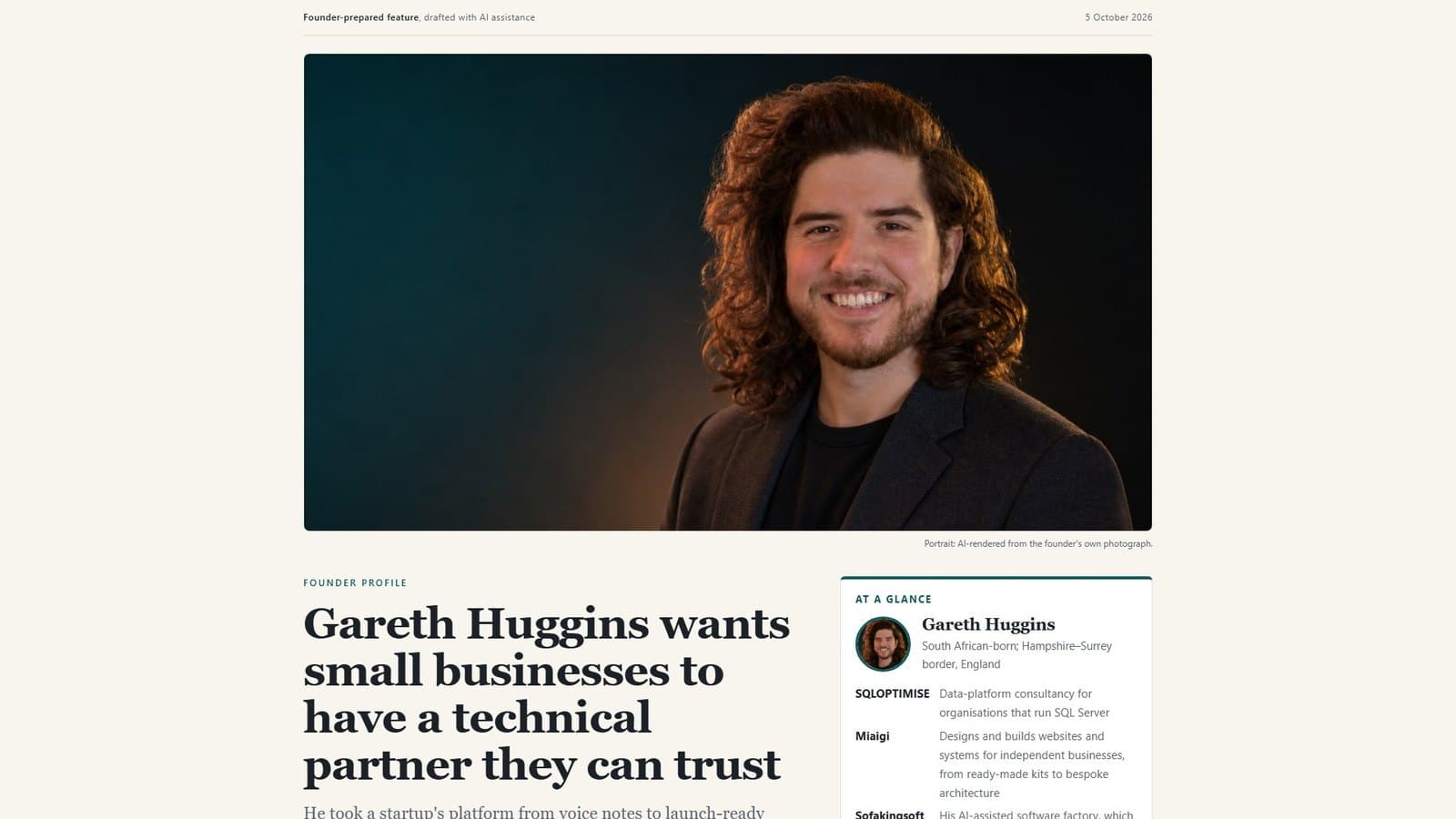
The output worth leading with: a 49-second stage introduction the skill made for its own worked example. Arena announcer and track from ElevenLabs, composed with the open-source /brag skill by Shunit Haviv Hakimi and Hyperframes; every spoken line maps to the verification sheet; the portrait is AI-rendered from my own photograph.
A database person's instinct, when asked to write something flattering about themselves, is to ask where the data came from. That instinct turned into a tool.
Founder of the Year is a skill for Claude Code. Given access to a founder's own systems, it writes a confident, magazine-style profile of them and their businesses, and alongside it a verification sheet that maps every consequential sentence to its source. I built it, then ran it on myself and my three businesses. This post is about the engineering: how an AI agent gathers evidence from real systems without inventing, and what broke on the way.
The shape of the problem
Language models are fluent. Fluency is the enemy of provenance. Ask one to "write a profile of X" and it will produce something plausible, and plausible is exactly what you cannot publish about a real person.
The skill's design answer is a pipeline that treats text as the last step, not the first:
- Discover what you can reach. Before reading anything, inventory the environment: connected tools, signed-in command-line tools (
gh auth status), local folders that look like a notes vault, machines reachable over SSH, the company's websites, the public register. Record what is readable, what exists but is out of reach, and what you will not open (personal, family, health, employment, finance). - Gather, read-only. Every source has an adapter that says what it can and cannot prove. A notes vault proves what the team believed on a date, not what is true. A repository's created and pushed dates prove that work existed and when, not that it shipped. A CRM stage proves an engagement is real, not that the client is happy. A credential filter (
grep -v -i -E "password|secret|token|api[_-]?key|bearer|BEGIN (RSA|OPENSSH)") runs before any file is read. - Ask once. Whatever the systems cannot answer becomes one batch of questions, each with a default, so work continues while the founder is busy.
- Choose the story, then write it, then check it: one evidence pass, one editorial pass, one mechanical pass for the label, the banned words and the private names.
The claim ledger is a data problem
The heart of it is a tab-separated file: one row per candidate claim, with the exact source location, the source date, the access date, a status (founder account, company page, independent record, writer's interpretation) and the editorial treatment. The article is written from the ledger, not from memory. The verification sheet is a sanitised projection of it: no private paths, no figures, no confidential terms, never the full ledger.
If you have ever built lineage for a reporting pipeline, this is the same idea. The row says where a number came from and how far you can trust it, and the report inherits that trust rather than asserting its own.
What broke, and what it taught the skill
Public pages carry other people's photos. A public LinkedIn page offered a 400-pixel portrait that was not me. The fix was procedural, not technical: no AI-rendered portrait is produced until the founder confirms the exact reference image, and the rendered result is compared against it before use.
Parallel calls look like abuse. Five text-to-speech requests fired at once were refused by the speech service's abuse check; the same five requests one at a time all succeeded. Agents should serialise calls to rate-sensitive services by default.
PDFs leak paths. A relative link in the HTML footer became a file:///C:/... annotation in the printed PDF. The pack review caught it; the footer is now plain text and the published copy gets its link back at build time. Check link annotations, not just visible text.
A file that opens alone. The HTML looked broken when opened from a zip because its images sat in a sibling folder. Images are now inlined as data URIs before handover. Obvious in hindsight; invisible until someone opens the file on a phone.
Small models for the legwork, a strong one to decide. Research and review run on a smaller model at moderate effort with one bounded question each; the lead model validates their findings rather than redoing them. The pack review on my own feature found three real problems, including a sentence that had quietly drifted beyond the founder's recorded decision.
Where this fits with the day job
Everything in the data-platform work I do for clients comes back to the same question: can you show where this came from? The AI SQL audit copilot works that way, and so does aDBA, which refuses to change anything it cannot explain and logs every decision. A profile-writing agent with a claim ledger is the same discipline pointed at prose.
The skill is open source: DEX-CON-ONE/founder-of-the-year. The worked example in its docs is the feature it wrote about me, with the verification sheet beside it. If you build agents over systems you are responsible for, I would like to hear what you would add to the ledger.
Founder-prepared, drafted with AI assistance. If you want help making your own SQL Server estate explain itself, talk to us.
Need Expert SQL Help?
Our SQL optimization experts are ready to help you implement these strategies and optimize your database performance.
Schedule Free Consultation